Saturday, December 30, 2017

It's Snowing! Heck, it is winter!

I am mostly annoyed and somewhat amused at the on-air pundits and weather forecasters who are quick to jump on the weather related Armageddon that is just a winter in New York. These guys usually set off a major grocery store stampede that leaves shelves stripped of bread, milk, beer, soda and chips...the vital necessities for urban survival.  Because we live so close to the ocean...well, just on the ocean, our temperatures are on average, higher than the rest of New York State and the Eastern Seaboard, so most storms are not as violent here as even thirty miles north. That is not to say that we have never been summarily "dumped" upon by Mother Nature.  We have had our fair share of double digits worth of snow, raining and hailing No'easters and full blown hurricanes...I recall Sandy, Gloria and Carol as particularly destructive. And I do appreciate those meteorologists who temper their forecasts with statistics and constant reminders that their science is not an exact one.

In retrospect, I appreciate the teachers I had in elementary school who took the time while teaching geography to explain and show and diagram for us and with us just how weather and climate work.  I remember designing  "weather maps" in which we colored in the different types of climate: Artic, Sub-Artic, Tundra, Temperate, Continental, Mediterranean, Tropic, and Sub-Tropic. We also learned how to read weather maps with their warm and cold fronts and precipitation symbols. I still like looking at those maps in our local paper.  When I taught Earth Science at the intermediate level, I would use those maps to teach the concept of latitude and climate even using them to track hurricanes and snow storms.  I would also play, "How much snow will fall on Mrs. Swanson's car?" if a storm was predicted or if it began to snow during the school day.  It is interesting what seventh graders will do to get a homework pass. They would bet down to an eight of an inch. It was one fun way to introduce math skills to real world problems.

But, I guess this is not so much a part of the curriculum these days...my teacher peeps can let me know if these skills at still being taught to our children today. It just seems we ,as a society, have become too dependent on the "talking heads" on local networks, cable or on other social media for information they are basically reading to us.  Most of them have experience in broadcast journalism, but very few are meteorologists. They are referred to as "weather forecasters", but not meteorologists. Meteorologists are part of a larger group known as Atmospheric Scientists.  Most atmospheric scientists work indoors in weather stations, offices, or laboratories. Occasionally, they do fieldwork, which means working outdoors to examine the weather. Some atmospheric scientists, like Sanitation workers,  may have to work extended hours during weather emergencies. Their median wage is $92400 per year, nothing to sneeze at, and their employment opportunities are projected to grow by 12% over the next ten years. Most of these folks are employed by private industry.

So, my question is: Why are we listening to weather forecasters who are not the real deal instead of the professionals? Have you ever been "spooked" and then "fooled" by their forecasts?  Shall I count the ways? Okay, so I am now looking at about 3/4 of an inch of snow that began falling at 9am. Maybe the forecast for one to two inches is correct.  Too bad I  haven't played my snow depth game since retirement.  I could have been the big winner today.

Wednesday, December 13, 2017

Looking back

I have been around the block more than a few times and I have a very long memory when it comes to all things political.  I was bitten by the political bug at a young age when I first saw John F. Kennedy in a motorcade in Manhattan during his presidential campaign in 1960.  It was also my first tickertape parade, so it made quite an impression.  I remember watching the local television reporter that evening who had stood a few yards from the spot where my Grandmother and I stood near the Battery in lower Manhattan as this constant fall of paper tape cascaded and whirled around us before it hit the ground. Kennedy was young, strong, and decidedly ruggedly handsome with a glint in his eyes that charmed the general public.  My father, a veteran of World War II who, like JFK had sustained injuries while in combat, was enthusiastic about this campaign, and voted for him that November.

I remember watching the election results being reported on our black and white set with flip card numbers being used by the anchors who reported results as they came in on the telephone.
Because of a major snow storm, schools were closed on that Inauguration Monday and we were able to watch the swearing in ceremony and the parade that followed.  I remember Robert Frost being there reading a poem, "The Gift Outright".  In a later iteration, I would watch Maya Angelou reading her poem written for a later inauguration as well. She read her "On the Pulse of a Morning" at Bill Clinton's Inaugeration in 1993, the only poet asked to be at one of these ceremonies thirty-two years after Frost.

In between those two events there were other memorable elections: Mario Cuomo as Governor of New York, who was later at the swearing in of his son, Andrew Cuomo, our current governor; David Dinkins and Ed Koch both elected mayor of New York; Jimmy Carter,  Ronald Reagan, the Bush's father and son, Barack Hussain Obama,  and finally the election of 2016 and the ascent of Donald Trump.

The current days of political screaming and yelling has brought me back to other similar events of the past: the Watergate scandal and downfall of Richard Nixon. I remember it almost as if it were yesterday, and I can see and hear the ghosts of Richard Nixon, HR Haldeman and Martha Mitchell as I watch the current flock of White House staffers scramble to  duck and cover from the inevitable fall out that is soon to come.

I remember my Aunt Marie, at first annoyed that her favorite afternoon soap opera was pre-empted by the hearings on the hill in the House, and the work and presentations to the panel of Congressional representatives, one of whom, Elizabeth Holtzman, was my congresswoman. She later sat hypnotized by the hearings, watching every broadcast wondering how this would affect her daughter who was working in the White House as part of the Nixon clerical staff.  She survived, and went on to serve three more presidents. I remember the very glamorous and blond Maureen Dean who sat stoically behind her husband John who told Nixon "There is a cancer on the White House." Dean has emerged after doing his time  to be a commentator and talking head on various cable news networks.  I am not sure if he is still with Maureen.

I can remember that it was not so much the botched burglary at the Watergate Complex...a place my cousin was living in at the time, but the cover-up that was the "gotcha" moment. I feel we are headed down that same path now.  This is becoming the proverbial "train wreck" you can see coming, but just can't stop. I hope I am wrong, but as a student of history, I know it can repeat itself, if people do not heed it or learn lessons from it.  Perhaps it is time to dust off that old copy of "All The President's Men" and send it to some folks inside the Beltway.

For your reference:

The Gift Outright

The land was ours before we were the land's.
She was our land more than a hundred years
Before we were her people. She was ours
In Massachusetts, in Virginia,
But we were England's, still colonials,
Possessing what we still were unpossessed by,
Possessed by what we now no more possessed.
Something we were withholding made us weak
Until we found out that it was ourselves
We were withholding from our land of living,
And forthwith found salvation in surrender.
Such as we were we gave ourselves outright
(The deed of gift was many deeds of war)
To the land vaguely realizing westward,
But still unstoried, artless, unenhanced,
Such as she was, such as she would become.

On The Pulse Of Morningby Maya Angelou 

A Rock, A River, A Tree
Hosts to species long since departed,
Mark the mastodon.
The dinosaur, who left dry tokens
Of their sojourn here
On our planet floor,
Any broad alarm of their of their hastening doom
Is lost in the gloom of dust and ages.
But today, the Rock cries out to us, clearly, forcefully,
Come, you may stand upon my
Back and face your distant destiny,
But seek no haven in my shadow.
I will give you no hiding place down here.
You, created only a little lower than
The angels, have crouched too long in
The bruising darkness,
Have lain too long
Face down in ignorance.
Your mouths spelling words
Armed for slaughter.
The rock cries out today, you may stand on me,
But do not hide your face.
Across the wall of the world,
A river sings a beautiful song,
Come rest here by my side.
Each of you a bordered country,
Delicate and strangely made proud,
Yet thrusting perpetually under siege.
Your armed struggles for profit
Have left collars of waste upon
My shore, currents of debris upon my breast.
Yet, today I call you to my riverside,
If you will study war no more.
Come, clad in peace and I will sing the songs
The Creator gave to me when I
And the tree and stone were one.
Before cynicism was a bloody sear across your brow
And when you yet knew you still knew nothing.
The river sings and sings on.
There is a true yearning to respond to
The singing river and the wise rock.
So say the Asian, the Hispanic, the Jew,
The African and Native American, the Sioux,
The Catholic, the Muslim, the French, the Greek,
The Irish, the Rabbi, the Priest, the Sheikh,
The Gay, the Straight, the Preacher,
The privileged, the homeless, the teacher.
They hear. They all hear
The speaking of the tree.
Today, the first and last of every tree
Speaks to humankind. Come to me, here beside the river.
Plant yourself beside me, here beside the river.
Each of you, descendant of some passed on
Traveller, has been paid for.
You, who gave me my first name,
You Pawnee, Apache and Seneca,
You Cherokee Nation, who rested with me,
Then forced on bloody feet,
Left me to the employment of other seekers--
Desperate for gain, starving for gold.
You, the Turk, the Swede, the German, the Scot...
You the Ashanti, the Yoruba, the Kru,
Bought, sold, stolen, arriving on a nightmare
Praying for a dream.
Here, root yourselves beside me.
I am the tree planted by the river,
Which will not be moved.
I, the rock, I the river, I the tree
I am yours--your passages have been paid.
Lift up your faces, you have a piercing need
For this bright morning dawning for you.
History, despite its wrenching pain,
Cannot be unlived, and if faced with courage,
Need not be lived again.
Lift up your eyes upon
The day breaking for you.
Give birth again
To the dream.
Women, children, men,
Take it into the palms of your hands.
Mold it into the shape of your most
Private need. Sculpt it into
The image of your most public self.
Lift up your hearts.
Each new hour holds new chances
For new beginnings.
Do not be wedded forever
To fear, yoked eternally
To brutishness.
The horizon leans forward,
Offering you space to place new steps of change.
Here, on the pulse of this fine day
You may have the courage
To look up and out upon me,
The rock, the river, the tree, your country.
No less to Midas than the mendicant.
No less to you now than the mastodon then.
Here on the pulse of this new day
You may have the grace to look up and out
And into your sister's eyes,
Into your brother's face, your country
And say simply
Very simply
With hope
Good morning.

Tuesday, September 5, 2017

A New Meaness in America

As a child growing up in mid-fifties/sixties New York City, many of the people I interacted with were immigrants or children of immigrants. The school I attended, Nativity on Classon and Madison in Bed Sty, was both racially intergrated and immigrant friendly. My classmates were children of Cuban exiles, young Hungarian political refugees, immigrants from West Africa,  offspring of African American migrants from post-World War II South and Puerto Rico....whom, by the way, were and are American citizens  I clearly remember one family whose father owned and operated a chain of Chinese laundries himself having escaped China after the Communist take over, and his strikingly beautiful and brainy bi-racial wife, African American and Irish, who kept both him and the books in line. Their five off spring were stellar students.

Fast forward to my years at Hunter College where I sat in classes with a wild group of Italian immigrant boys who played a wicked game of soccer and spent many hours off the field and out of the classroom convincing as many "American" girls as they could into "tutoring" them in their use of English slang. Other classmates were children of Ukrainian immigrants on the Lower Eastside and Haitian immigrants in Brooklyn learning to speak proper English as we studied to become teachers in the polyglot culture and halcyon days of New York City in the early seventies.

In one of my first post-college jobs I worked at a bank with an French girl whose family ran a restaurant in Hell's Kitchen, a very Irish colleen whose brogue was so thick I was often called on to translate what she was saying, and the branch manager, a refugee from eastern Germany and the Iron Curtain. It seemed that my life in New York City was crisscrossed many times over by interactions and encounters with immigrants of all stripes from Europe, Africa, the Caribbean and Latin America.

Up until the 1920's there were no immigration limits in this country. My paternal grandparents arrived here about 1913 immigrating from Ireland.  Family lore has it that my grandfather left Ireland using his brother's passport, not sure how true that it (and my cousin who is into genealogy will set me straight). Quotas were placed to limit "undesirables"...Asians, Eastern Europeans and Jews...from having easy access to settling in the United States.

During the tenure of my career as an educator, I have encountered more and more immigrants, most of the students were from the former Soviet Union, Africa and Latin America.  Many entered this country legally, and others did not.  In New York City, which is one of those "evil sanctuary cities" that some folks rail against, the policy of the school system was quite "laissez faire". We were in the business of educating children, not reporting them. That is exactly what we did. Most of the immigrant families I dealt with were serious about the children learning English, getting educated and at the very least, finishing high school. I found these students to be hard working who were not ashamed to be hustling on the weekends working in restaurants washing dishes, mowing lawns and bagging leaves, shoveling snow or doing whatever they could to provided more income for their families. Most of the parents of these children seemed to be doing jobs that most other folks did not want to do.  Many mothers were cleaning houses and fathers were employed by landscape services or worked on heavy manual labor work crews as day laborers. Some of the parents arrived under visitor visas and overstayed the time allotted, but the children were not the ones who purchased the tickets, made the trip and decided to stay. They were and are caught in a vicious cycle.

Which brings me to the decision today of the present administration to recind the Executive Order referred to as DACA, Deferred Action for Childhood Arrivals, commonly referred to as "The Dreamers' Act", offering a pathway for children who arrived with their parents to remain in this country, usually the only country they have ever known. Most elected officials, economists and industry leaders agree  that these 800,000 people should remain; they are overwhelmingly productive adults or students in high school and college, none have any history of arrest or wrongdoing, and many are married to Americans; some are even serving in the military. But our Commander-in-chief did not agree; these folks are fodder for his ongoing feud with Congress; DACA must be ended...down the road a bit, but ended, unless, that is, Congress does something; that way he is off the hook. Our ChImage result for statue of libertyief Executive did not even deliver this decision on his own, he had the Attorney General do it for him.  And as usual, in a written statement, he blamed the former president and Congress for his actions.  It's their fault; they should have done their job; his predecessor is at fault; don't blame him, he just got into office; he is just the messenger. His press secretary spent more than her fair share of time this afternoon trying to convolutedly defend this action. She was dancing as fast as she could
claiming it was a campaign promise he intended to keep, to get meaningful immigration reform, to strengthen our borders, and to rid the nation of "bad hombres".

I just wonder what Emma Lazarus would think of this. You remember. She wrote the poem that is inscribed n the pedestal of the Statue of Liberty, "The New Colossus":

"Not like the brazen giant of Greek fame,
With conquering limbs astride from land to land;                                        
Here at our sea-washed, sunset gates shall stand
A mighty woman with a torch, whose flame
Is the imprisoned lightning, and her name
Mother of Exiles. From her beacon-hand
Glows world-wide welcome; her mild eyes command
The air-bridged harbor that twin cities frame.
“Keep, ancient lands, your storied pomp!” cries she
With silent lips. “Give me your tired, your poor,
Your huddled masses yearning to breathe free,
The wretched refuse of your teeming shore.
Send these, the homeless, tempest-tost to me,
I lift my lamp beside the golden door!”


Friday, August 18, 2017

Slavery/Confederates and the Culpable North

Pensacola Daughters of the Confederacy

Over the past several days, the conversations in the nation have tunned to long neglected feelings surrounding race in Trumpian America.  I have always felt that race is, and always was, the elephant in the collective American living room; a living room we all kind of sit around in looking at each other muttering to ourselves that there is something there that we just want to disappear.When Americans think about the Civil War and the reasons why it happened, many will tout the idea of "states' rights" or "agrarian economy v manufacturing economy". They are both pieces of the whole, but the overarching reason for the war was the existence of what many reconstructionist historians have called that "peculiar institution", involuntary servitude, in plain English, slavery.


In times past, those of us who were born and raised in the northern and western parts of the country have felt a bit smug and superior that this part of the nation was on the side of the angels and would shake our heads, suck our teeth and wag our collective finger at those Rebel Boys, those agents of Satan, who fought to keep all those people enslaved.

That never was the true picture. The truth is, as the Cubans would say, complecado.

African slaves were introduced to New Amsterdam in 1626 when eleven African slaves were brought into the colony.  In 1655 the first slave auction was held in New Amsterdam. By 1705 over 42% of New York households owned slaves; the second highest percentage of cities in the colonies, second only to Charleston. In 1711 a formal slave market was established at the end of Wall Street on the East River, and it operated until 1762. New York State, due to the work of the New York Manumission Society under the leadership of John Jay and Alexander Hamilton, gradually eliminated slavery, and by 1827, slavery no longer existed in the city or state.

But slavery still was part of the economic underpinning that fueled our city's economy. Brooks Brothers started their now high end clothing empire producing basic clothing for slave merchants. Back in the day, around 1850, 339 of the first 1,000 policies written by New York Life were on the lives of slaves. Brown Brothers Harriman, one of the largest private investment bankers in New York, was founded by William and James Brown who owned slaves, financed the cotton economy, and went on to establish Brown University, one of America's Ivy League schools.  And finally, Domino Sugar, that purveyor of all things sweet, was the Brooklyn company that packaged, promoted and pushed the use of white refined sugar that was picked and processed on the slave dependent-plantations of the South and the Caribbean. There are no heroes here.

Which brings us to the question at hand that we, as a nation, are currently wrestling with, what do we do with those monuments erected to the sacred memory of the fallen leaders of the Confederate States of America. And, since opinions are like noses, and everybody has one (thank you, Joan Filippone for this reference), there are many proposals floating around. So here are mine.

One of the things I do when I travel is have a theme for photos.  In Europe I take photos of World War I monuments.  In the Caribbean, I take photos of flowers and fauna.  In the Southern part of the United States I take pictures of Confederate War Memorials.

There are two distinct types of Civil War Monuments. One set is the formal horse and rider, sword rattling, hat raising leader a la Robert E. Lee or Stonewall Jackson. Theses are the official kind often in places like parks and courthouse plazas. They represent the idea that "the south will rise again", and were often erected during the era of Jim Crow and segregation to recall the past glory days, and enforce the laws that denied folks their civil rights. These need to be moved from places of prominence and into a local history museum or other place set aside for them to quietly reside. Remember, these military leaders were leading a rebellion against the United States of America and were technically traitors. Yes, most of them were not prosecuted as such due to the interjection of former Union officers who had studied with them at West Point, but the fact that they chose to betray their nation still remains true.

Greensborough, Confederate soldiers monument
The other set is a different matter.  These are often small town monuments to local young men who perished in the service of the Confederacy.  Many of these men were buried where they fell, and families had no grave where they could lay flowers and say prayers. The grief of the family was real, as real as the grief of a Northern family who suffered the same loss. These markers served that purpose and should remain, or be placed in local cemeteries.

So, there it is...just my humble opinion. You are also entitled to yours.


Monday, August 14, 2017

Dating in your sixties part 2

Image result for sixties teen age dancesBack in the nineteen-sixties, I was in my adolescence attending an all girls' Catholic High School located in Rockaway Beach which is in the borough of Queens in New York City. Every Friday evening a neighborhood Catholic Church would sponsor  a dance for teens who lived in the various adjoining Catholic parishes. Here they could meet other, religiously acceptable, possible life mates under the watchful eye of our beloved Father Keppler, then a young prelate who would remind those who dared to dance too closely to "leave room for the Holy Spirit." In my adolescent  mind the image of the Spirit as dove and embracing teen-aged bodies merely made me laugh, at least to myself. Now every once in a while a Protestant teen would show up, usually a friend of one of the guys who attended the local public high school; itself a kind of scandal....well, attending Sty or Brooklyn Tech was understandable, but Midwood, Tilden or Madison!  Anathema.
                                                                                                            
As my life unfolded, I met and married one of those Protestant boys who attended James Madison High School.  We were together until his unexpected death five years ago. A few months ago, I decided to get back in the game, and try online dating for seniors fifty years and older. It has been an interesting ride.

I have read the profiles of at least a hundred or so men on this site.  Most are pretty straight forward; they are looking for someone to spend time with.  Others are a bit bizarre: no vegetarians, no city dwellers, no country bumpkins, no vegans, no Democrats, no Republicans, only blonds, only red-heads, no grey-haired grannies. Those are the ones that get quickly taken off my list. Others are looking for someone to relocate and take care of them....not gonna happen, buddy.

I have actually met three of these fellows face-to-face. Each one had a very different story.  Each one had his charms and his drawbacks. Family obligations, alimony, child support, retirement, no retirement, income limits, business responsibilities, long distance parenting, these were among the concerns many of these guys have. I realized that I am not likely to quickly  jump into another relationship since most of the men I have talked to are carrying around a lot of baggage I would rather not unpack.

It has been entertaining, I admit, a diversion from daily obligations and work.  I am not sure at this point if I will renew my membership once it expires in a few months, but I will check the site for some daily entertainment. My friend Dave, himself widowed, but now married to his high school sweetheart, recently told me "You have to kiss a lot of frogs before you find a prince." Well, I am not a fan of amphibians, I just may sit out this dance.

Tuesday, August 1, 2017

Youthful Conversions

This summer I spent some time in Europe following in the steps of two well known figures of European Christianity: Martin Luther and Jeanne d'Arc. These two may seem like polar opposites to many. He was a serious scholar, monk, priest, husband, father and student of theology.  She was a child of the rural countryside whose spirituality was based on heavenly visions that urged her on to do God's work in her beloved France. But they both underwent religious conversions in their youth that had a profound effect on their lives and those of millions of other Christians.


Joan/Jeanne was born in the very little town of Domremy-la-Pucelle in Lorraine probably on January 6,1412.  It was said that she was born on the feast of the Epiphany. Her parents were farmers, and her home is preserved next to the small church in the village in which Joan/Jeanne was baptized. Her times were those of turmoil. France and England were embroiled in the Hundred Years' War, and the land of her birth was being fought over by both forces.

At the age of thirteen Jeanne/Joan began to hear her "voices".  She identified them as St. Michael the Archangel, St. Margaret and St. Catherine of Alexandria whose statues were in the local church. These voices told Jeanne/Joan that she was to lead the French army against the English and make sure the prince, Charles of Valois, was crowned king.  When Joan was sixteen, her father had arranged for her to marry, but she had other ideas.  She had taken a vow of chastity, and somehow managed to get an audience with the prince and convinced him to let her lead his army as a divinely inspired act.  No one knows what she said to him, but he gave her command of the troops.  She led them to a great victory in Orleans. Unfortunately for her, she was later captured by
Jeanne D'Arc Domremey
the English; tried for heresy condemned to death.  It did not help that Jeanne/Joan opted to wear men's clothing while leading the troops and when speaking to the powerful...kind of like the "power suit" of the day. She paid dearly for that.

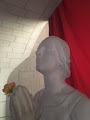
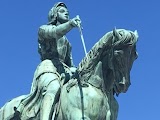
At the tender age of nineteen she was burned at the stake as a witch.  Her ashes were scattered in the Seine River in Rouen, the cathedral town of her trial. Joan was not canonized until 1920, but the people of France think of her as their special patron, protector and patriotic symbol.  You can find statues of her all over France.  From Paris to Orleans her triumphant figure sits tall astride a muscular steed gracing  many public squares;  in cathedrals and churches there are statues, murals and stain glass windows dedicated to her memory. She is the Maid of Orleans, the soul of France; I was told by one of our guides, himself an immigrant to France now married to a Frenchwoman and running a small tourist business that "If there was no Jeanne D'Arc, there would be no France, and if there was no France, there would be no democracy. And where would the world be without democracy?"  A bit over the top, and I am sure he has not read Thomas Paine or even de Tocqueville, but I got the drift.


Young Martin
Image result for martin lutherMartin Luther had a more conventional childhood.  He was born November 10, 1483, some seventy years after Jeanne/Joan into a middle class family.  He was a brilliant student and went off to University in Erfurt at the age of nineteen in 1501; he earned a Master's degree in 1505 at the ripe old age of twenty-three. Martin was a very serious student, and he often complained about the beer drinking and skirt-chasing ways of his fellow undergrads. I think we might even consider him a bit of a serious party pooper and stickler. But he was brilliant and his father urged him to continue his studies to become a lawyer.  Unfortunately for Papa Luther, it was not to be.


Martin has his conversion experience during a severe thunderstorm in which he was nearly struck by lightening.  If he survived, he swore to St. Anne, he would become a monk.  And he kept true to his word. He entered the Augustinian Monastery in Erfurt continued his studies. His propensity for frequent daily confession drove his superiors to distraction, yet he was ordained to the priesthood in the Roman Catholic Church in 1507.  By 1512 he had earned two additional bachelor degrees and his doctorate in theology. He went on to teach in the university at Wittenburg, the town in which his Ninety-five Theses was written, displayed, and where he eventually lived out his life with the woman he called his "Kate", his wife, the former nun and beer maker, Katarina Von Bora with whom he had six children.  She definitely was the leaven in his life; balancing all things domestic and economic and basically keeping him on an even keel.

And despite time spent in exile, writs of excommunication, papal trials, writings on indulgences, translations of scripture, and Peasant Revolts, he dies at home at a considerable old age for his time, sixty-two. Luther laid the foundation for the Protestant Reformation and its profession of redemption "by faith alone". There is also unfortunately, the fact that in his later years, Luther's wrote scathingly of the Jews of Europe whom he thought would flock to convert once they read his translations of scripture into the German vernacular; they did not.

Looking back on my journey, which might have seemed disjointed to some, I realized that many of us can look back and rationalize the experience of these two Christian figures.  One tour guide suggested that Martin's entry into the monastery had more to do with the fact that his father wanted him to marry a newly widowed wealthy older women from their hometown. A psychiatrist I met on the plane suggested that Jeanne/Joan was bi-polar and suffered from delusions. Methinks these are modern practitioners  using modern diagnostics on folks long gone.  For the people of France, Jeanne/Joan is the personification of their nation, more than any Bourbon king, Napoleon or elected president. And for millions of Christians, Luther was the reformer who stood up and spoke truth to power. Others may disagree, but his theological work is still studied today.

Another thought on these two: We should not dismiss the fervor of youth who are willing to stand up for what they believe. So many of us have lost that spark  Looking at the lives of Jeanne/Joan and Martin should be a reminder to us all that it is often the young who have the clearer vision and the gift of leadership.

Tuesday, July 25, 2017

Traveling behind the iron curtain

I have returned from a month of travel in Europe encompassing six countries: The Netherlands,  Germany, Hungry, Slovakia, Czech Republic and France. It was a multi-purpose trip: celebrating a friend's birthday, visiting sites related to the life of Martin Luther and the 500th anniversary of the beginning of the Protestant Reformation, visiting Budapest and Prague, because they were nearby, and walking in the steps of Jeanne d'Arc with  a group of teenaged girls on their Journey to Adulthood pilgrimage.

As you can imagine, it was a monumental trip.  Planning for the Luther leg and Jeanne d'Arc journey were several years in the preparation, identifying accommodations, booking tours and guides in various cities and towns, locating reasonable hotel space, finding the perfect mountain top restaurant from which to view the town of Wartburg, climbing the Fishermen's Bastion in Budapest, viewing Wenceslaus Square and the Astrologic Clock in Prague, and timing the visit to the Eifel Tower so it glittered as we ascend the Metro steps to the Trocadero, these were the many facets of a month "on the continent".  They were wonderful moments that will remain in my memory forever.


My friend, Peter, was born in what was known as East Germany, but escaped with his family to live in the west. There were several people at his birthday party who had grown up in the eastern part of the country, the "red" kind, the "communist" side...as we post-World War II kids, thought of them, as we were taught. We knew that the real Evil Empire was located behind that imaginary curtain that separated east and west Europe, friend and foe, democracy and tyranny, goodness and evil. And we knew that the people who lived there were both suffering and brainwashed. But what did they think of us? Surprisingly, they thought the same thing.  


Jeanne d'Arc/ Orleans, France


But there were other eye-opening moments. The interactions with folks who grew up on the other side, the "evil" side of the infamous "Iron Curtain" was a most interesting part of the trip.


From restaurant at Romantic Hotel in Wartburg

Our tour guide in Wittenburg told us how excited he was as a young child to see real soldiers with real guns in his town.  He related how he was taught in school that the Americans were evil incarnate and would come in and shoot them all if they could.  The Russian soldiers were there to protect them. He now laughs at it all, but it was not so funny when he was a six year old school boy wondering when and if the Americans were going to shoot and kill his parents and grandparents.

Two retired educators, a husband and wife, told us that their jobs depended on tacitly accepting the status quo and how one got along under the rule of the East German puppet government. They shared that even though they were baptized as Christians in the Lutheran Church, neither they nor their parents practiced that faith because to do so would mean your career would suffer and economic hardships, something they all faced, would become more and more unbearable.

And the greyness of the landscape was ever-present. Roads were grey; streets were grey; houses were grey, office buildings were grey; churches were grey; shops and stores were grey; life in general was grey. Food choices were extremely limited.  The wait to buy a new state manufactured car was fifteen years; a used one was more expensive than a new one because it was more readily available. There was no unemployment and everyone had a place to live, but housing often came with no heat nor hot water, and the jobs were redundant.

There is still a remnant of this mindset in the local hospitality industry. During this trip I stayed in five hotels/inns located in what we would consider to be behind the "Iron Curtain". It was an experience.

Central European accommodations are sketchy at best.  We stayed at world-wide chains and small family owned spots; old world grey ladies and modern hotels retro-fitted into beaux arts buildings near the riverfront. But one thing sort of stuck out: a radically different welcome is needed. A few suggestions follow:

1. Have a list of nearby interesting sights/museums/shops to offer guests; special pricing or discounts are a plus.

2. Recommend and call local restaurants to check on availability. Know their price point as well.

3. Have a taxi service on call.

4. Make sure you have at least one (BBC would work) English language station in your cable  offerings. I do not mind Al Jazeera English, but others do.

5. Keep your in-house restaurant/bar open and available for your guests.

6. Know where the closest post office, ATM, cash exchange, bank and hospital are located and how to get there easily.

7. Offer a space for local artisans to display and sell their wares.

8. Have coffee/tea making opportunities in the room; a refrigerator is a plus.

9. Have comfortable lobby seating.

10. SMILE!!!!!

Go to Central Europe...it is reasonable priced and lovely.  The people are warm and the sights are interesting.